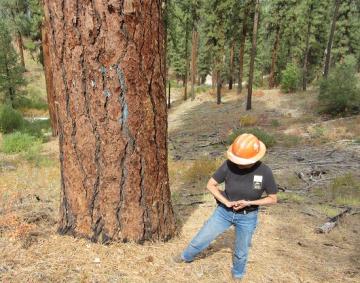
The Boise Basin Experimental Forest (BBEF) near Idaho City, Idaho, was established in 1933 to study management of ponderosa pine (Pinus ponderosa), with modern research focused on multiple use management, wildland-urban interface, forest restoration, erosion control, and wildlife habitat. The forest is a total of 8,740 acres, split between three separate units: Headquarters, Bear Run, and Bannock Creek. Each unit has a unique management history, with Bannock Creek containing the oldest ponderosa pine and many relatively undisturbed areas (e.g. Bannock Creek Research Natural Area).
Much of the BBEF consists of ponderosa pine with co-dominant or undergrowth of Douglas-fir (Pseudotsuga menziesii), predominantly as post-mining regeneration since nearby Idaho City was a booming mining town in the 1870s. Mountain shrub communities occur on shallower soil sites and on upper slopes and ridges. A full list of vascular plants, bryophytes, lichen, and fungi found on the experimental forest was compiled in 2024.
Elevation ranges from 3,937 to 11,909 ft (1,200-3,630 m) across the forest, with generally deep soils of coarse to moderately coarse texture that come from granitic rocks of the Idaho Batholith. The climate is characterized by warm, dry summers (average temperature 66.2 °F [19 °C]) and cool, wet winters (average 24.8 °F [-4 °C]). Annual precipitation averages 25 inches (635 mm), with the most falling from October through June.
Documents
- Physical and chemical characteristics of surface fuels in masticated mixed-conifer stands of the U.S. Rocky Mountains
- Effect of particle aging on chemical characteristics, smoldering, and fire behavior in mixed-conifer masticated fuel
- Northern Rocky Mountain Experimental Forests: settings for science, management, and education alliances
- Effects of topographic features on postfire exposed mineral soil in small watersheds
- Fuels treatments in ponderosa pine - Visits to the Boise National Forest and Boise Basin Exp. Forest
- One-hundred years of wildfire research: A legacy of the Priest River, Deception Creek, and Boise Basin Experimental Forests of Idaho
- Experimental forests and climate change: views of long-term employees on ecological change and the role of Experimental Forests and Ranges in understanding and adapting to climate change
- Impacts of forest management on runoff and erosion
- Erosion rates from forests and rangelands following fuel management
- Stand and fuel treatments for restoring old-growth ponderosa pine forests in the interior west (Boise Basin Experimental Forest)
Recorded Media
Past Events
- Sep 17, 2014