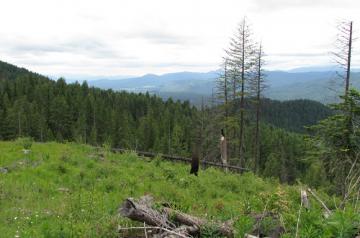
In 1911 the Priest River Experimental Forest (PREF) was among the first sites to be set aside by the USFS for the purpose of conducting forest research. Since its establishment, numerous educators, FS researchers, and state and private forestry personnel have used the Forest. Research conducted by J.A. Larsen, Harry Gisborne, Ken Davis, Charles Wellner, and Irvine Haig provided information on basic forestry principles still used today for managing Rocky Mountain forests.
The range of elevations and aspects on the PREF supports several mixed-conifer forest types. The five major forest types include subalpine fir (Abies lasiocarpa), grand fir (A. grandis), Douglas-fir (Pseudotsuga menziesii), western hemlock (Tsuga heterophylla), and western redcedar (Thuja plicata) trees. Western hemlock occupies about half of the forest with equal distribution among the other tree species on the other half of the forest. More than 60% of the forest is in mid- to late-successional stages with trees 100 years or older.
Documents
- Physical and chemical characteristics of surface fuels in masticated mixed-conifer stands of the U.S. Rocky Mountains
- Effect of particle aging on chemical characteristics, smoldering, and fire behavior in mixed-conifer masticated fuel
- Climate, snowpack, and streamflow of Priest River Experimental Forest, revisited
- One-hundred years of wildfire research: A legacy of the Priest River, Deception Creek, and Boise Basin Experimental Forests of Idaho
- Northern Rocky Mountain Experimental Forests: settings for science, management, and education alliances
- Integrated fuel/restoration treatments - Field tour at the Priest River Experimental Forest
- The Missoula Fire Sciences Laboratory: a 50-year dedication to understanding wildlands and fire
- Experimental forests and climate change: views of long-term employees on ecological change and the role of Experimental Forests and Ranges in understanding and adapting to climate change
- The role of experimental forests in science and management
- Impacts of forest management on runoff and erosion
- Erosion rates from forests and rangelands following fuel management
- Treatments that enhance the decomposition of forest fuels for use in partially harvested stands in the moist forests of the Northern Rocky Mountains (Priest River Experimental Forest)
- Mastication: a fuel reduction and site preparation alternative
- Using digital terrain modeling and satellite imagery to map interactions among fire and forest microbes
- Size class structure and tree dispersion patterns in old-growth cedar-hemlock forests of the Northern Rocky Mountains
- Clearcutting and burning slash alter quality of stream water in northern Idaho
- Fire behavior in Northern Rocky Mountain Forests
- Meteorological factors in the Quartz Creek forest fire